Love & Monsters
Series 2, Episode 10
Written by Russell T. Davies
Aired 17th June 2006
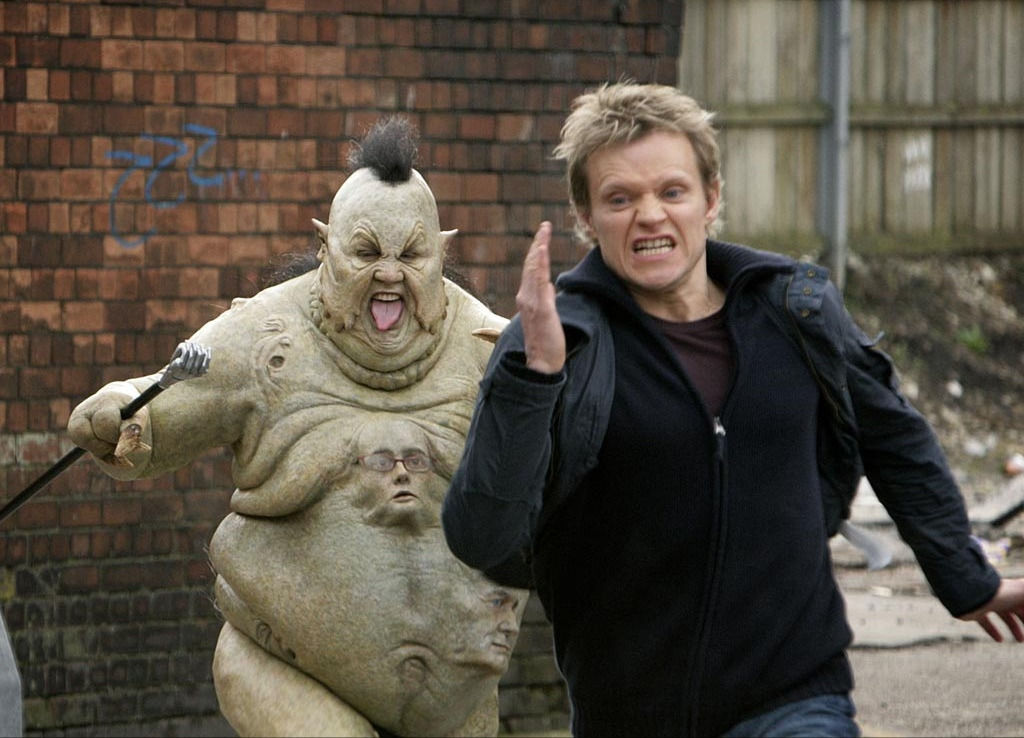
“Turns out, I’ve had the most terrible things happen.
And the most brilliant things.”
– Elton Pope
Experimentation is important. In general, certainly, but in particular for Doctor Who, a show defined by the regular recasting of its lead role. Indeed, ‘Love & Monsters’ – an experiment itself – wouldn’t exist were it not for the BBC taking the risk of reviving its 20th century flagship for modern audiences under the stewardship of Russell T. Davies, a soap opera writer; and I can say comfortably that the decision to create 2.10, the first ‘Doctor-lite’ episode, was basically a good one. Not to say, though, that the execution matched up to that idea.
The idea of the ‘Doctor-lite’ episode, from a production standpoint, was to minimise the stars’ presence to make filming easier, but it had the ultimate creative impact of diversifying the perspectives through which the audience saw the world of Who – it presents the opportunity to show viewers how everything looks through a radically different pair of eyes. The ‘lite’ suffix has found its way onto some of the show’s all-time best stories by forcing writers to radically shake up their approach – there’s no ‘Blink’ without this episode. It’s a shame, then, given the importance and value inherent to ‘Love & Monsters’ in the show’s history, that it isn’t itself any good. Indeed, 2.10 is a notoriously lousy outing, one whose influence far outstrips its lacklustre entertainment value. It perhaps deserves a visit out of respect for what it represents, but not much on its own merits.
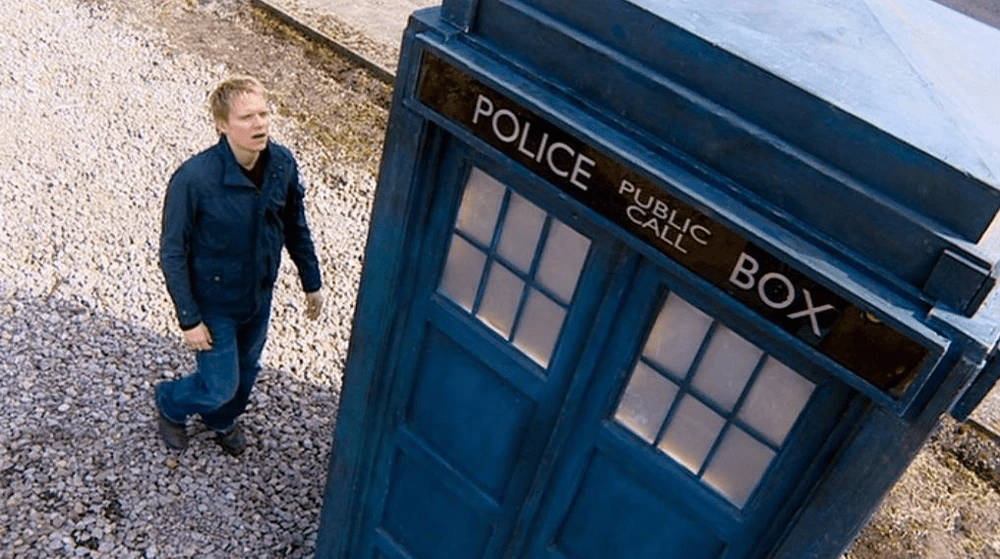
The episode never really fulfills the promise of its cold open
The decision to focus a story on an ordinary man who stumbles upon the supernatural provides the opportunity to take 2.10 in a myriad of directions. Indeed, the cold open shows the episode’s protagonist, Elton Pope, literally wandering into the Doctor and Rose’s alien hunt – a good tone-setter that gives viewers a good idea of the core ‘muggle explores new world’ theme. But Davies does not choose to double down here – he carefully rations out the top-billers’ screentime and limits the explicit supernatural to the front and end of the episode. Granted, I think withholding ‘monsters on the screen’ is effective in raising the intrigue and anticipation around the Doctor’s world that the episode is clearly aiming at, but only to a point. After all, the episode is so domestic and pointedly explores so little new ground that it doesn’t so much build up to a big monster reveal as unceremoniously spring it on the audience. Ultimately, the greatest impact that this creative decision has is to make the episode less fun; it does not feel like a Doctor Who episode. Of course, the mere act of not fitting formula is not the issue – as mentioned, some of the show’s best outings do that exactly – but ‘Love & Monsters’ does not feel so much like a different spin on the science-fantasy show as much as it feels like some kind of spinoff, and a much less entertaining one at that. Elton working to find Rose via her mother Jackie makes for fine domestic drama – as well as going some way to make her character more sympathetic – but it’s not really very Who, even given the very suburban focus of the first two series. It all comes together to give the final impression of a weirdly boring outing, one so focused on reinventing the wheel it forgets how to make itself run – how to make itself fun.
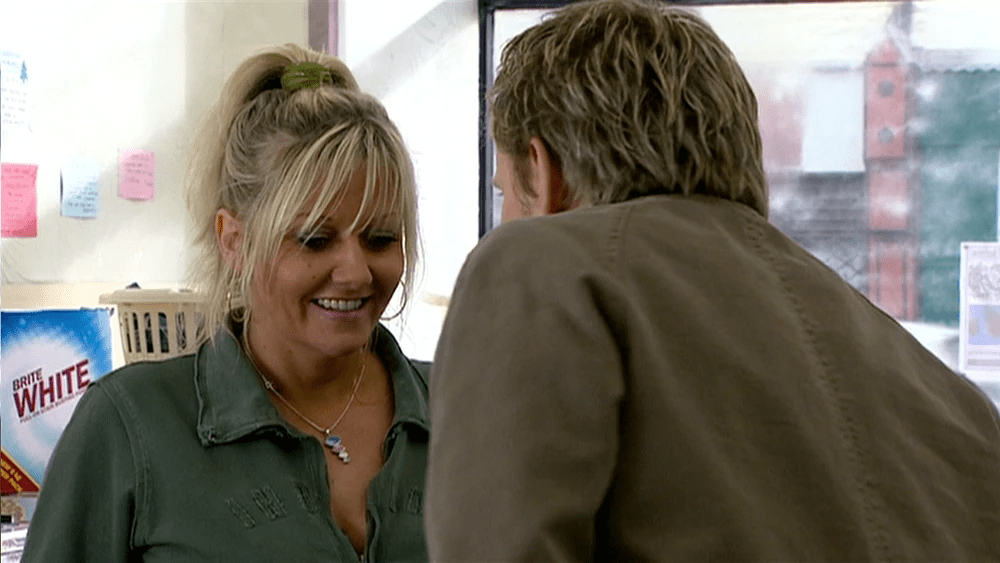
Admittedly, Davies does more for Jackie’s character here than in two series of TV – but that probably says more about the other episodes
This is not to say that Davies completely squanders his strengths here. Probably the greatest facet of his penmanship is his character-writing: he has a particular proficiency in creating characters that audiences care about even in the limited span of 45 minutes. Elton himself is a perfectly well-grounded and likeable outsider – not the most inspired one-off character, but a solid addition in any case. The other members of ‘LINDA,’ an association of Elton and a few others who have encountered the Doctor, are also plenty relatable, though I think it is telling that Elton’s love interest, Ursula, is the only one of them that I could really remember. Perhaps the screentime that the episode affords to Jackie Tyler, a character that had largely recurred as a wet blanket throughout the first two series, is its best decision; it certainly didn’t hurt to have someone linking the episode back to the rest of the continuity, and we see Jackie in a much more sympathetic light here. It’s legitimately a clever writing move from Davies to portray Jackie – after so many episodes of her through the Doctor’s perspective, a hindrance and a nag – as a real person who is starting to feel a toll from years of her daughter’s travels. All this is to say that the episode makes shrewd use of the extra space afforded by the absence of our leading duo; the focus on the ‘ordinary people’ is the episode’s greatest strength, but this unfortunately betrays a real problem. 2.10 does succeed in creating a cast of relatable characters, but it doesn’t really take advantage of them. Usually, the ordinary people throw the extraordinary circumstances into sharp relief, but here there is no such contrast – there is not enough for the cast to actually do.
Still, even if LINDA’s members are forgettable, as an anchoring concept it deserves credit. In them, RTD presents an in-universe fandom – he draws out the fandom of the show that he himself is part of and creates a kind of fictional mirror. In doing so, he sets the episode up as a commentary on the impact that the show has on people, running the impact of ‘Doctor Who’ and the show Doctor Who in a clever parallel to each other. To apply the lens of meta-narrative, 2.10 seems to present the notion that Who – and media like it – can be a conduit for connection and community, or it can be ruined by obsession and gatekeeping. This is an interesting idea; while I think it leans a little hard on the idea of the connection itself and doesn’t do much to explore the merits of the actual source of connection (e.g. the Doctor/the show), I appreciate that one can only accomplish so much with 45 minutes and I commend Davies for provoking the audience to think beyond the text and about the meaning that it can hold to people. In an age where we as a society have drifted apart in person and increasingly come to be defined by our connection over shared interests, it’s a prescient creative angle – in particular, exploring the darker side of fandom is something that has the potential to resonate well beyond the date of airing. Unfortunately, Davies chooses to explore this darker side of fandom through the form of the Abzorbaloff, probably the worst villain of the 2005-2010 run.

Euck
Bluntly put, the Abzorbaloff is a bad joke. It’s too ridiculous to be scary, too ugly to be cool, and too visually flat to be weird in an interesting way. It is lousy and repulsive on its literal face. I will grant that its role in the story – disguising itself as a slightly eccentric human in order to get close to the Doctor and then pick off the members of LINDA, one-by-one – is not uncreative, but even so, it is just another monster of the week. It’s a pretty generic alien that lacks screen presence (except perhaps in making viewers avert their eyes), interesting lore or a unique motivation, let alone something interesting to say about the universe in which it exists. Further, I’m not sure how it slots into the aforementioned toxic fandom idea if the villain is obsessed with the Doctor not because of any relatable personal issues but because it’s an alien that wants to eat the Doctor. That background just makes it generic. The notions underlying ‘Love & Monsters’ – of ordinary people, the double-edged nature of fandom, the danger of the Doctor’s world – are not well-served by the villain, who provides the story with a deeply predictable conflict – I do like how the absorbed LINDA members along with Elton himself are the ones to undo the monster, but even then it’s not an especially interesting resolution. Sure, the cast meet a grim end because they poked around in the Doctor’s business, which on some level demonstrates him to be a dangerous influence, but any other villain could do that. The Abzorbaloff offers nothing that a different monster couldn’t offer better, and it’s good that it never showed up again.
But for as much as I might slag off the villain of this outing, the Abzorbaloff can’t shoulder all the blame for it not working. 2.10’s “human story” – that is, the personal development that its protagonist goes through – concerns Elton’s relationship with the members of LINDA, particularly Ursula, and the nature of his past encounter with the Doctor. For the latter point, the problem is not so much that it ruins the payoff of explaining what this meeting with the Doctor means, and more that it doesn’t really set it up in the first place. In an early scene, Elton explains that he has a faint memory of meeting the Doctor as a child, which is later revealed to be a memory of the night his mother died – this critical piece of context is only delivered at the end, and it’s the first we really hear about anything happening in Elton’s family. Had we heard in even one line of dialogue at any point that Elton had lost someone close to him, we would have had the pieces for the script to put together, but we don’t. What could have been a competently-delivered, if still painting-in-lines, emotional moment, is less than that – it’s a resolution in search of a setup. The plotline (if you can call it that) is half-assed – literally half of it is left out.
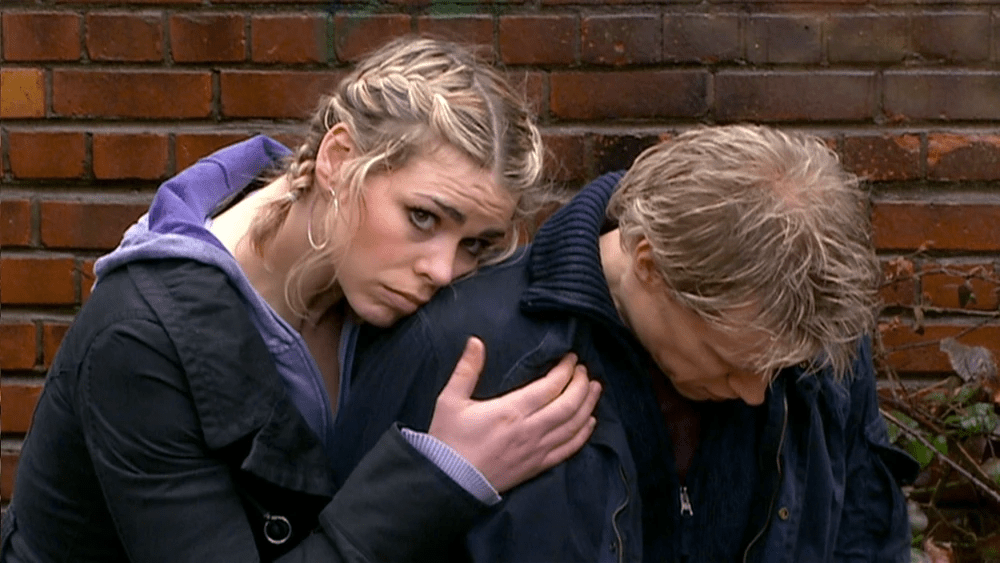
You know, I think she could’ve kept the braids
Finally, the episode sabotages its own cautionary message about getting mixed up in the Doctor’s world – something meant to foreshadow the fate of the Tylers with blazing unsubtlety – in the way it handles the fate of Ursula. She and Elton grow close via LINDA, only for her to ultimately be absorbed by the monster, disappearing with it as it dissolves.
“But thinking back, I was having such a special time, just for a bit, I had that nice little gang… and they were destroyed… maybe that’s what happens, if you touch the Doctor, even for a second.”
The message is that the world of the Doctor seems like a lot of fun, but ultimately it’ll break your heart – right? Wrong. In fact, the Doctor is able to retrieve Ursula’s consciousness, preserving her in concrete, and the two maintain… well, how does Elton himself describe it?
“It’s a relationship. Of sorts. We manage. We’ve even got a bit of a love life-”
It’s mildly nauseating to see the episode portray this fate as a halfway-good outcome, but I don’t think any of us want to think about Elton getting blowy from a pavement slab, so let’s leave it there. The ending of ‘Love & Monsters’ doesn’t so much wrap up the episode’s disparate threads into something cohesive as much as it provides a turd on top of an altogether bad script, and ruins any promise its ideas had in the name of cheap gags.

I think it speaks for itself
So, if ‘Love & Monsters’ was an experiment, what were the results? What can we conclude? By ranking it second-worst in the entire 2005-2010 run, you might think I’d grade it an unequivocal failure, but I wouldn’t. 2.10 is very flawed, and I wouldn’t hesitate to call it a bad episode, but I wouldn’t call it a waste of time either. If Davies set out to prove a concept – that there could be merit to the world of Doctor Who even without the Doctor – he was successful. While I think that his proof of concept could’ve been better in most ways, be it regarding general entertainment value, the monster of the week or even basic writing concepts like setup-payoff, it was a success in creating likeable characters who could stand on their own, without the charismatic title character to anchor the story. ‘Love & Monsters’ is certainly overshadowed by its successors in the format, but it’s important, and it succeeds in the ways that it really needed to. Unfortunately it still sucks in general, so I’m not going to be revisiting it any time soon.
 Site Title
Leave a comment