The Idiot’s Lantern
Series 2, Episode 7
Written by Mark Gatiss
Aired 27th May 2006
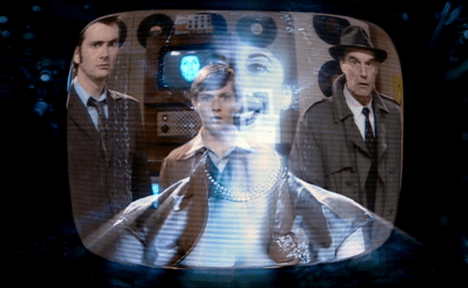
“HUNGRY! HUNGRY!”
– The Wire
What makes something ‘the worst’ of its cohort? In a TV context, the answer, for my money, is fairly obvious: it’s the episode(s) that you’d least like to watch again. Within the first four series of Doctor Who – the ‘first Russell T. Davies era’ or RTD1 – there’s some debate over which story is the weakest, but I’ve always held that ‘The Idiot’s Lantern’ takes the title handily. It’s neither entertaining nor thought-provoking, both tacky and charmless, entirely forgettable for a lack of merit and yet still memorably bad at points. It is filler without fun. It’s rare for me to charge an episode of Doctor Who as unambitious, so believe that 2.7 truly sticks out for how dull it is. There are other stories of the era with more actively unappealing about them, but no other episode contains so little good. Mark Gatiss’ missteps here range from subtle to baffling – most notably by including a truly bad aesop, but the episode would still be very poor besides. It’s utterly flat and has nothing in the way of rewatch value – and in a show that brims with variety and invention as much as Doctor Who does, that’s galling indeed.

Ten’s never looked so tacky
This lack of creativity that cripples the episode is probably best demonstrated by the choice of setting. By itself, there’s nothing wrong with 1950s London – it does provide the ground to explore some interesting ideas, as will be discussed – but in the context of Series 2, it’s downright clichéd. Of the seventeen TV stories of NuWho up to this point, seven (or eight, if you count ‘Rise of the Cybermen/The Age of Steel’) had been set in postwar London. What exactly is the point of travelling through time to land (in the grand scheme of things) at basically the same point? Doctor Who has always been infamous for attempting to pass quarries off as alien worlds – thin pretensions of settings more ambitious than the show could ever pull off – but even the flimsiest tries at different settings would be preferable to a time and place for which you don’t even need to bother suspending disbelief. I’ll grant that it’s a convincingly-made period piece, vintage cars and all, but the episode does not convince me that Who needed to go to the ‘50s. The overriding sense one gets from the episode is that it doesn’t try anything new – you could skip it and miss out on little. Our leads spend the first third of the runtime hopping around a street in London in sequences that feel rather devoid of anything clever or fun, so most of the entertainment value ends up resting on the cast – which doesn’t really do much to redeem it either.
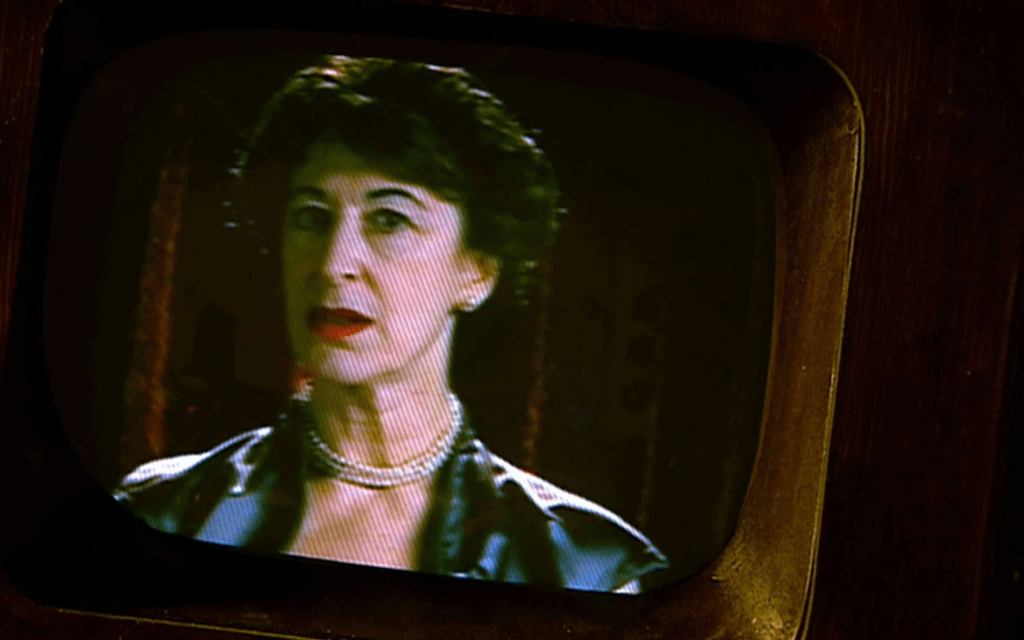
It’s not a good sign when the highlight is one character’s ridiculous overacting
I’ll grant that the villain of the week, the Wire, is at least entertaining, albeit in a one-dimensional way. As little more than a woman on a screen, the Wire follows the rest of the episode in lacking any real sense of the alien or supernatural, so her presence is entirely reliant on Maureen Lipman’s acting. While she hardly provides a masterclass of range, Lipman’s performance does add something the episode sorely lacks otherwise: a sense of fun. The Wire is patently ridiculous every moment she’s on screen, and it does little to make for a more imposing or significant villain, but I’d expect about as much from this episode. She’s the best part by default – the only part of 2.7 that I would consider memorably entertaining – so I can’t really grumble too much about how flat she is as a presence in the story. This is, after all, filler. The episode asks to be taken particularly seriously, and I hardly expect a brilliant, boundary-pushing monster of the week. Still, much like everything else in the episode, there’s scant little to interrogate or examine further. Would it be too much to ask for a modicum of depth behind the gimmick?
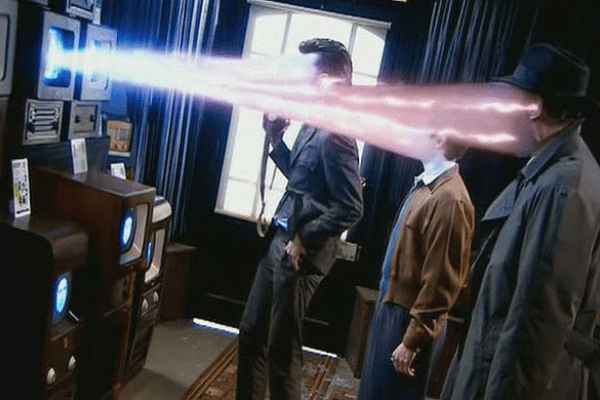
I’ll grant that the effects here aren’t bad
Then again, given how Gatiss botches the attempts at depth here, maybe I should count my blessings. ‘The Idiot’s Lantern’ is a story largely about the Doctor and Rose’s encounter with a stereotypical nuclear family, one dominated by an equally stereotypical abusive patriarch. The Doctor, predictably enough, berates the man of the house for his behaviour, and Gatiss takes this image of tradition to task for its thinly-veiled structure of abuse. The old ways, Gatiss tells us, were not really so good – put a pin in that. On paper, at least, I appreciate using an episode of Who as a vehicle to examine a period of history and deconstruct widespread perceptions of a time period that many look at with rose-tinted lenses: it’s a smart use of the format to critique a particular time period ethos. So I find it particularly ironic that Gatiss ends up reinforcing the gender roles – the trope of the ‘underwritten female lead,’ as Christopher Eccleston put it – of the classic show when the episode sees Rose fall victim to the Wire, a beat that mainly serves to Make It Personal to the Doctor.
I also think it does a disservice to Rose. After all, a key aspect of her character has always been her resourcefulness, and previous episodes went out of their way to show how an ordinary working-class girl could make a difference even in the face of cosmic horrors. This nicely dovetailed with the core ethos of the first Davies era: that ordinary people are important, and rendering her a ‘damsel in distress’ defeats that idea – not to say that Rose always has to be a headstrong #girlboss in every episode, but I find this a pretty inexcusable degradation of her character. As if it weren’t bad enough itself, the episode proceeds to replace Rose in its latter half with the young boy of the family, which makes the rest of the runtime straightforwardly less interesting.
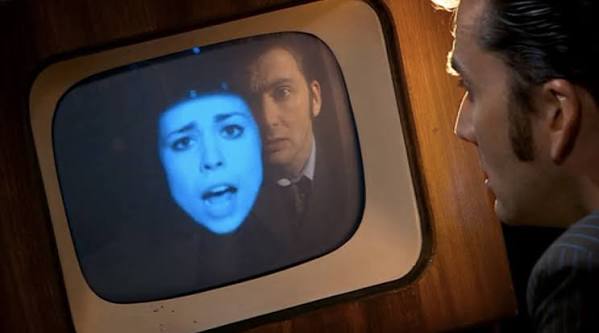
Stuffing Rose into the fridge – or, rather, the screen – somehow isn’t Mark Gatiss’ worst writing decision
The episode presents its events through a curious framing device: the coronation of Queen Elizabeth II, which here serves as a deadline by which the Doctor must banish the monster of the week. The Wire ‘feeds’ via the television, sucking out the souls of the hapless viewers. In this way, Gatiss presents a kind of subversion of patriotism: an event that unites the country is presented as an opportunity for the villain to exploit. Between the Stepford-smiling Connolly family and the police coverup of the Wire’s victims, a more tangible theme emerges of ‘keeping up appearances’ – which, again, fits well with Gatiss’ decision to centre the episode on a critique of stereotypical ‘50s suburbia, though I think he could and should have pushed this idea further. And more than that I’m mostly struck with a faint notion of ‘new technology bad’ in having the most TV-skeptic character be proven right, and in an amusingly on-the-nose way:
“I heard they rot your brains. Rot them into soup and your brain comes pouring out of your ears, that’s what television does!“
Unfortunately, the only point of real substance – the biggest takeaway on any thematic level – from the episode is a jarringly terrible aesop about family trumping all, abuse included. Gatiss tees himself up to take his deconstruction of the romanticised midcentury family unit and turn it into a message of standing up to abuse – to have the boy seriously confront his father, the symbol of the dark side of this romanticised time. Gatiss does not do that. Rather, he has Rose (a woman, it’s worth noting, who grew up without a father) tell the boy to forgive his terrible parenting because they are family, and has the Doctor – the same man who tore the father a new one earlier in the same episode – tacitly agree. What the fuck?
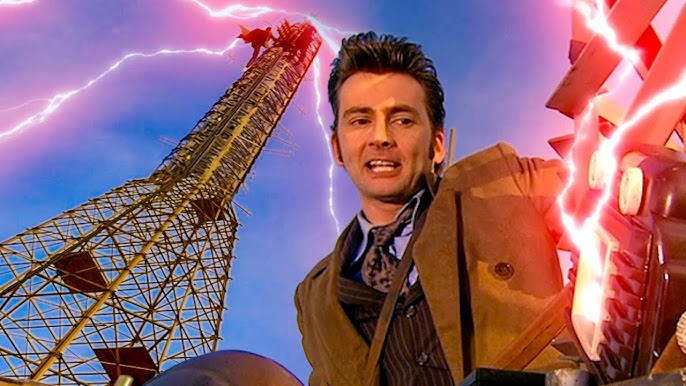
… er, I take back what I said about the effects
My biggest issue with ‘The Idiot’s Lantern’ isn’t that it’s offensive, of course. While this thorough botching of its central theme is a stinging failure, I would extend the episode just a little leniency if the rest of it had any real merit. Ultimately, its greatest crime is being boring. It has a single good joke – where the Doctor flashes his psychic paper and pretends to be the King of Belgium – and a so-bad-she’s-good villain, but really the only thing close to a standout aspect is Tennant’s cheesy slicked-back hair that thankfully did not infect any other episodes. There are a couple of stories that place above 2.7 in the face of more actively unappealing elements because I can at least say that there’s something thought-provoking or at least a little entertaining about them. No such joy here. ‘The Idiot’s Lantern’ evokes in me, as a viewer, a sense of bored antipathy, mild disgust, and next-to-nothing else. I can say confidently that it’s the least worthwhile episode in the first four series of Doctor Who, and it isn’t particularly close.


Leave a Reply